Mission planning and ground control for custom UAVs.

Plan against aircraft performance, forecast wind, terrain, airspace, and radio coverage, then fly the mission from the same cockpit. Flightdeck is in alpha, with the cockpit focused on ArduPlane fixed-wing aircraft.

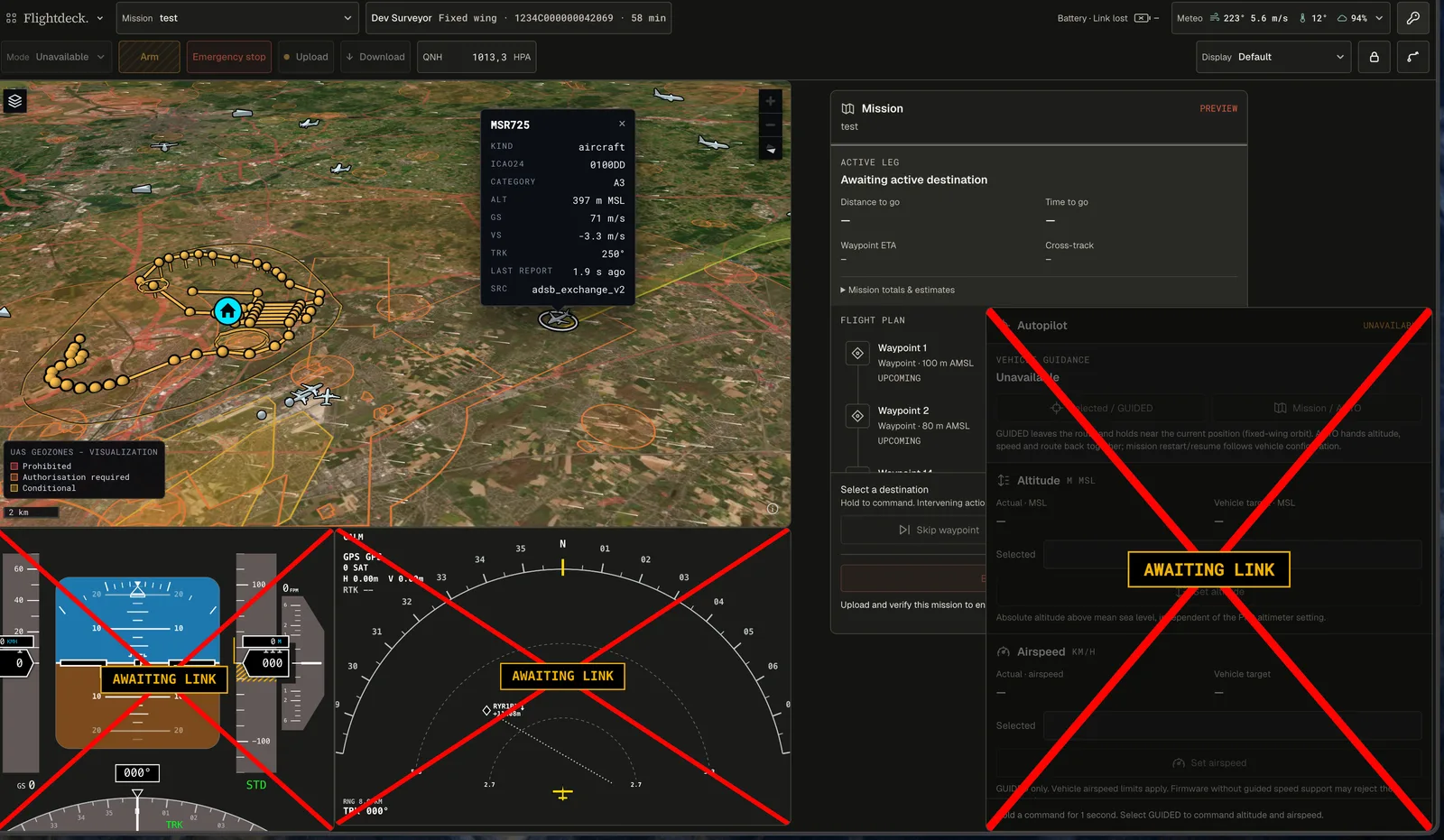
Flightdeck cockpit with a planned fixed-wing mission, UAS geozones, and ADS-B traffic on the map beside the mission panel. With no aircraft connected, the flight instruments read Awaiting link.

Wind changes the plan.

The same fixed-wing survey, simulated with and without forecast wind.

Wind-aware
4m 59s
Wind ignored
4m 35s
Difference
+24s
Survey route simulated with wind ignored. Survey route simulated with forecast wind.

Capabilities

Flight-path planning

Build terrain-relative surveys against an aircraft profile. Flightdeck estimates the flown path from turn performance, climb and sink limits, and forecast wind, and flags terrain and obstacle conflicts. Imports and exports QGroundControl plans.

Camera footprints

Project supported fixed-mount cameras onto the terrain along the simulated path, using lens intrinsics, distortion, mounting, and aircraft attitude. Footprints show potential visibility, not verified image coverage.

Airspace review

Check the predicted trajectory against geozones, obstacle clearances, and A3 separation, alongside the operational window and weather.

Radio coverage

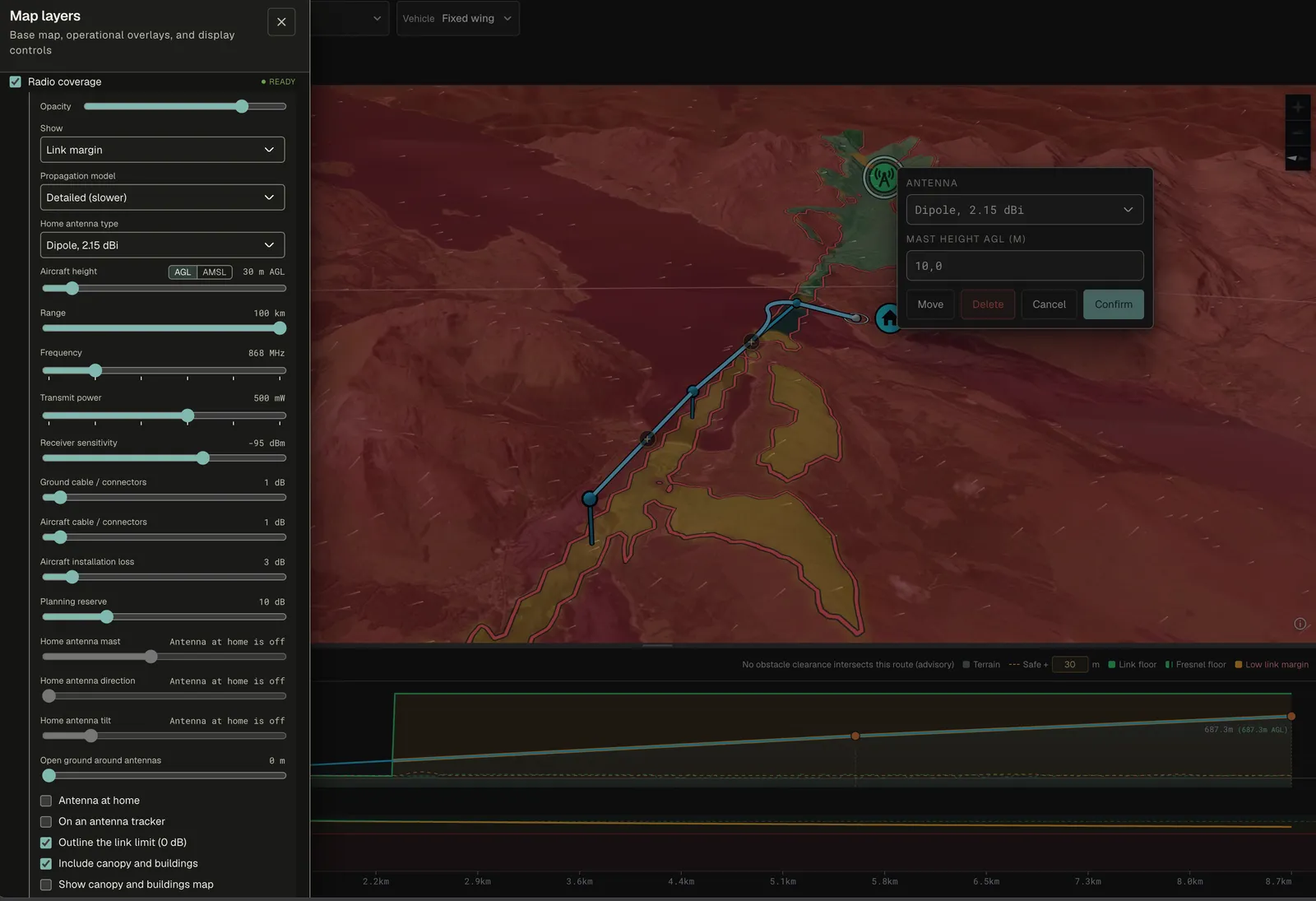
Predict link margin over terrain, land cover, and Earth curvature from your antennas and link budget, including the lowest usable altitude along the route. The radio setup is saved with the mission.

Cockpit

Flight instruments, mission progress, map actions, manual control, and acknowledged commands, with WebRTC video, ADS-B, Remote ID, radar, and weather in one view.

Field tools

Configure SiK radios, run a u-blox RTK base, flash ArduPilot and PX4, inspect MAVLink, edit parameters, and download vehicle files, all in the browser.
Flightdeck radio coverage layer showing predicted link margin over mountainous terrain around a fixed-wing route, with antenna settings and the route's terrain and Fresnel clearance profile.

Start with one aircraft.

One vehicle, one autopilot, one payload, one operation. We agree up front what is supported and where integration ends.

Each vehicle gets its own private Flightdeck runtime, linked to the aircraft over QUIC. Operators authenticate with SPIFFE mutual TLS, and a single exclusive write lease gates every command to the aircraft.

What you get

  • Supported configuration and integration boundary
  • Aircraft profile and autopilot integration
  • Private deployment and PKI
  • SITL or hardware-in-the-loop acceptance
  • Field evaluation against your requirements
  • Operator runbook, known limitations, and support terms